Friday, December 26, 2014

SEVEN SENSATIONAL MEDICAL ADVANCEMENTS OF 2014

1. THE BIONIC EYE


The “Argus II” takes video from a camera built into glasses (as shown in the picture) and wirelessly transmits that image to implants in the retinas of blind patients. The technology has been available in Europe since 2011, but it was approved for use in the U.S. by the FDA in 2014. The technology is not perfect, but it does help patient's distinguish white from black or the curb from the sidewalk.


2. BREAKTHROUGH TREATMENTS FOR HEPATITS C

Happy liver
In the past, Hepatitis C therapies had cure rates of about 70% and would take almost an entire year to complete. Not only that, but patients may have undergone injections with interferon that produced difficult to tolerate side effects. Now, there are newer oral drugs with cure rates of 91 percent to 100 %. These therapies only last 12 weeks and have been proven to treat more difficult to cure patient populations such as those who also have HIV. One major down side to these newer treatments are the price, they can set you back anywhere from about 85k to 95k.

3. THE POOP TRANSPLANT IN A PILL FORM

FECAL TRANSPLANTS

I know how this sounds, but fecal transplants have been helping people who have suffered with a serious infection called Clostridium difficile (C. diff). C. diff is a toxin that can produce life threatening diarrhea and in fact about 15k people die from it each year. C. diff is typically an infection that we see in hospitalized patients, immunocompromised patients or patients who have taken broad spectrum antibiotics.

When the usual antibiotic regimens don't work, poop transplants may actually do the trick and have pretty good success rates - some studies quoting 81%. The transplants work by replacing good bacteria from the donor poop into the recipients colon. At present the transplant is preformed via an enema, but recently researchers in Canada have been able to get the good bacteria (minus the poop) into an oral pill!

 4. THE CANCER GENOME


By reviewing the mutated genome of a tumor, we can now tell whether or not some cancers will respond to current chemotherapy regimens. This is helpful because if your doctor knows you won't respond to current treatments he or she can get help you make the decision to get into a clinical trial much sooner.

5. NEUROPACE, STOPPING SEIZURES BEFORE THEY START

neuropace rms NeuroPace Gets FDA Pre Market Approval for RNS Stimulator

Although the NeuroPace has been in development for some time, it was just approved by the FDA this year. The device is a neurostimulator - a small, battery powered device surgically implanted in the skull that continuously monitors brain electrical activity. The neurostimulator delivers brief pulses of stimulation when it detects activity that could lead to a seizure, this can help to prevent the seizure before it happens. Seizure activity has been reduced in participants by 40%.

6. IBRUTINIB, MISSILE GUIDED CANCER TREATMENT


Normally, cancer treatments kill good cells along with the bad cells. Researchers have discovered that the growth of some lymphomas and leukemias is controlled by a protein called Bruton's tyrosine kinase (BTK). Now there is a new drug called Ibrutinib that blocks BTK and leaves the good cells alone.

7. 3D PRINTED BODY PARTS

 
We've all heard of using 3D printers to replicate everyday household items or make toys, but did you know that scientists are using them to make embryonic stem cells, skin, blood vessels, heart tissue, cartilage, bone and organs? Some of these advancements are still in the works, but one day researchers may be able to help thousands of people who are waiting for organ donations by printing the organs they need using biologic material. Pretty cool stuff!

Wednesday, December 24, 2014

There's a new Surgeon General in town. What does that mean?


On December 15, 2014 Dr. Vivek Murthy was confirmed as the 19th United States Surgeon General. Educated at Harvard and Yale, Dr. Murthy is a Boston based Internal Medicine physician and educator at Brigham and Women’s Hospital and Harvard Medical School. He is the first Surgeon General of Indian descent and the youngest at 37 years of age.

After the confirmation, the Office of the White House released a statement stating “ Dr. Murthy will bring his lifetime of experience promoting public health to bear on priorities ranging from stopping new diseases to helping our kids grow up healthy and strong,”President Obama said in a statement , “Vivek will also help us build on the progress we’ve made combating Ebola, both in our country and at its source.” Murthy himself said as Surgeon General he would focus on preventing childhood obesity, increasing rates of childhood vaccination, and decreasing smoking rates as he is “deeply passionate” about disease prevention.

The Office of the Surgeon General is part of the Office of the Assistant Secretary for Health in the U.S. Department of Health and Human Services. In order to become the US Surgeon General a physician must first be nominated by the President of the United States then be confirmed by majority vote by the US Senate for a 4 year term in office.

With his new role, Dr. Murthy oversees all public health initiatives and programs for American citizens that involve the federal government's money. As the medical spokesperson for the federal government, he also represents its views on public health policy.  Referring to the prestigious role, the Office of the Surgeon General states that "As the Nation’s Doctor, the Surgeon General provides Americans with the best scientific information available on how to improve their health and reduce the risk of illness and injury. " A well known act done by a former Surgeon General was the Surgeon General Warning on tobacco products indicating it can be hazardous to health ( Rear Admiral Luther Leonidas Terry, M.D , 1964). The Surgeon General also awards several public health awards for exemplary acts of services as well as chairs the National Prevention Council, a  partnership of 20 different government agencies to promote community-based wellness programs including tobacco cessation and expanding access to healthy foods.

As the operational head of the US Public Health Service Commissioned Corps (PHSCC)  Dr. Murthy  will lead the Commissioned Corps, a group of 6,500+ uniformed health care professionals. These authorities,who are on call 24 hours a day, can be dispatched in the event of a public health emergency (such as Ebola), natural disaster, and assist in international health issues.  Along with their day to day duties which include holding offices within the NIH, CDC, FDA and other federal agencies, they also have a common  mission to protect, promote, and advance the health of the nation.

So why is a Surgeon General necessary? Essentially the Surgeon General is a leader, the American health leader. Though he can not directly affect policy making he can serve as a spokesperson and educator for critical health issues affecting physical, mental, and community well being. Important messages can be sent through the Office of the Surgeon General in a way that all people, no matter what level of medical knowledge, can understand. From obesity prevention, to the importance of seat belts this position works towards the unbiased prevention of illness, advocacy of wellness, and promotion of positive health activities.


Office of the Surgeon General


Sunday, December 21, 2014

Cole Said It Best

J. Cole

Michael Brown. Eric Garner.
I Can't Breathe. Hands Up. Don't Shoot.

 These are the names and terms that have been heard from the mouths of people across the country and globe for the past several weeks. The tragic shooting death of Michael Brown by Ferguson, Missouri police and the choking death of Eric Garner by Staten Island, NY police in 2014 have resonated in the souls of men, women, and children alike. The shooting death of 12 year old Cleveland native Tamir Rice by a police officer has also ignited fury and calls for justice for those affected by police brutality and a criminal justice system that has at times not acted appropriately towards members of the community.

Hip hop artist J. Cole said it best in the lyrics of his song "January 28", off the album 2014 Forest Hills Drive.
What's the price for a black man life? I check the toe tag, not one zero in sight~ J. Cole
 
African American men are continually dying in the hands of those that have sworn to protect them. There are many correctional officers who are doing a great job of serving their community, however there are a few whom may be doing more harm than good. After grand juries failed to indict the officers involved in the Brown and Garner cases thousands of protests, marches, and boycotts have occurred throughout the nation demanding change.

#WhiteCoats4BlackLives, a coordinated protest on December 10 by medical students in over 70 medical schools in the US and Caribbean was created to not only protest against racial discrimination and police brutality, but to also shed light on the injustice which happens to blacks within the health care system.

"Die-In's consist of medical students in white coats and other individuals laying on the ground, most for four and a half minutes- representing the four and a half hours that Michael Brown's corpse layed on the ground after being shot.

The hope in these demonstrations is to open a much needed dialogue amongst health care professionals, healthcare systems, and the general public about the large disparities people of color face in receiving sufficient health care. Racial discrimination in itself has a direct impact on mental health, leading to increased stress, behavioral issues, depression and suicide. To often minorities are unable to receive the medical help they need due to various socio-economic or prejudicial constraints. The alarming low rate of African-Americans matriculating into US medical schools is also raising concerns that lack of diversity amongst providers will  affect the patients' views and possible use of the health system. 

As student doctors we are obliged to recite the Hippocratic Oath during medical school. The oath is a public declaration of our aim to uphold certain ethical standards. Do No Harm (non-maleficence)  claims a physician will refrain from providing futile treatments or act with malice towards a patient.

I believe that just as physicians are held accountable for inappropriate conduct and malpractice, police officers should be held accountable for improper handling of force and weapons, as well as discrimination. How a choke hold is not considered unlawful is beyond my understanding, but the continual abuse of members of the general public by law enforcement needs to come to an end. Both the criminal justice system and the health care system are responsible for the general well-being of the community at large.If the public can not trust us, we who have dedicated our lives to helping them, then who can they trust?

Look at the nation, that's a crooked smile braces couldn't even straighten ~ J. Cole


Below are photos of various Die-In's

John Hopkins School of Medicine
Albert Einstein College of Medicine
Texas A&M Health Science Center College of Medicine

Morehouse College
Howard University School of Medicine
University of California, San Francisco

Harvard Medical School

Image Source

** OhemaasMD in no way supports the recent shooting death of two NYC police officers, in apparent revenge for Eric Garner

Tuesday, December 16, 2014

TIME Person of the Year


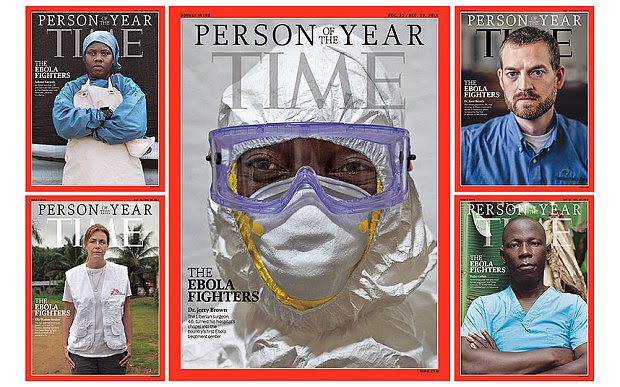
Last week, TIME magazine bestowed it's beloved award of Person of the Year, not to an individual but to an entity. The Ebola Fighters were named 2014's Person of the Year for their “tireless acts of courage and mercy." Recipients include the many doctors, nurses, and numerous health care workers working to end the epidemic which has already claimed over 6,000 lives. The people in the field also included Doctors Without Borders/Médecins Sans Frontières (MSF), and the Samaritan Purse Christian medical relief team. 

The epidemic, which initially wrecked havoc in Liberia, Sierra Leone, and Guinea eventually crossed international water with cases in the United States and Europe. The White House welcomed the TIME magazine award as a tribute to the "heroism and selflessness" of countless health care workers."The administration, including the president, could not be prouder of the brave men and women who've committed themselves to this effort in a foreign land," said spokesman Josh Earnest.


                                           TIME Magazine Ebola covers

The resilience, tirelessness, and dedication of  The Ebola Fighters is unrelenting and under appreciated. Fighting a disease which could (and did) easily claim their own lives, the health care workers put their own well being aside to take care of individuals and even entire families. We must also not forget the ambulance drives and burial teams who also aided in providing care and peace to thousands.
 The war against Ebola is not over and the global health system is not as strong as previously perceived. Those who are not on the front line can still help, by supporting organizations fighting in Ebola stricken countries like The Red Cross and Doctors Without Borders. Monetary contributions, supplies and even prayer are welcome. We are grateful to the Ebola fighters as TIME magazine stated, "For tireless acts of courage and mercy, for buying the world time to boost its defenses, for risking, for persisting, for sacrificing and saving".


If you would like to donate,
Mamawa Inc and Sierra Leone Water are two organizations  spearheading the war against Ebola in Sierra Leone.
Also check out Doctors Without Borders


Sunday, December 14, 2014

The Signs of a Heart Attack


I recently attended a lecture given by an Emergency Medicine physician about recognizing and treating a patient with a heart attack. The talk touched on some very important points and inspired me to write this post. Namely, it is important to know that the signs of a heart attack differ from person to person, from man to woman, and from young to old, BUT there are some COMMON SYMPTOMS that we should all recognize. If you or someone you know has these symptoms, seek medical attention without delay!

What exactly is a heart attack exactly? 


It is literally an attack on the muscle of your heart (called the myocardium). During a heart attack, cholesterol plaque that has built up in your coronary arteries over time (the arteries that supply your heart with blood) rupture. As the plaque ruptures, a clot forms in the artery and cuts off the blood supply to the part of your heart that the artery was supplying with blood. Your heart muscle needs blood, just like the rest of your body, to survive. Without adequate blood flow, the heart muscle dies or infarcts. This is where we get the phrase myocardial infarction. 

Rarely, a heart attack can also be caused by coronary artery spasm.

TIME is MUSCLE. The sooner you seek medical attention, the better!

What are the symptoms of a heart attack?

CHEST PAIN. Sometimes this PAIN is more of a discomfort, squeezing, fullness, burning or pressure. It is not limited to the aforementioned and takes many forms. Most heart attacks give you discomfort in the middle of your chest below the breastbone. The pain can last for several minutes or come and go.
DISCOMFORT. In both arms, the back, neck, jaw or stomach.
SHORTNESS OF BREATH.
OTHER Cold sweats, nausea, vomiting or lightheadedness.

According to the American Heart Association, "As with men, WOMEN'S most common heart attack symptom is chest pain or discomfort. But women are somewhat more likely than men to experience some of the other common symptoms, particularly shortness of breath, nausea/vomiting, and back or jaw pain."

What can I do to prevent myself from having a heart attack?

Medications. Take the medications your doctor prescribes and go for check ups regularly.
Maintain a healthy weight.
Don't smoke. Smoking significantly increases your risk of heart attack and stroke.  Do not stroke. I cannot stress this enough.
Exercise regularly. Aim for 30 minutes of physical activity everyday. Do strength training at least 2x per week.
Manage stress. Don't let people and circumstances stress you out! Manage stress with deep breathing exercises, working out, massages and relaxing vacations.
Keep conditions that can lead to a heart attack in check. For example, high blood pressure, high cholesterol and diabetes.
Eat a heart healthy diet. There is a restaurant called the Heart Attack Grill where you can get too much food for one plate! Waitresses dress up like nurses and can even push you around in a wheelchair if you so desire. In fact, you dress up like a patient to eat there! But the best and worst part is, if you are over 350 pounds you eat for free! To prevent heart attacks, don't do this!


Click HERE for heart healthy recipes from the American Heart Association.


Access the American Heart Association's Heart Attack Risk calculator by clicking HERE.

  
charades cartoon humor: 'It was unfortunate timing that he suffered his heart attack while playing charades.'

Tuesday, November 25, 2014

In Transition


 “Fear, uncertainty, and discomfort are your compasses toward growth.” ~Celestine Chua

There comes a time in life when old things come to an end and new beginnings must commence. For Jemina and I, that time is now.

We have finally made it to the final lap of what has seemingly been an endless race. As the concluding year of residency dwindles from months to days, the light at the end of the tunnel is shining brighter. This is a very exciting time in our lives but it is also speckled with anxiety. Most of the uneasinness comes from not knowing for sure what lies ahead.

What do I do next?
Where do I go?
Will I match into a fellowship program?
 What will I do if I don't?
Will I pass my board exam?
Am I happy with my career?

The biggest worry is concern over whether or not I'm actually a good doctor and know what I'm doing. We all suffer from lack of confidence from time to time and that feeling is heightened when your decisions impact the lives of others. I am reassured in the fact that I have been exceptionally trained and have experienced a multitude of situations which have improved my clinical expertise.

 Rather than dwell on the negative, I'm focusing on the benefits of transition and the positive impact it has. A few of the perks of transitioning include allowing me to

Shape my identity- I can confidently acknowledge who I am as a woman, physician, and mentor and ascertain I am proud of who I am

Refocus on life goals- I need to decipher what is important to me and create new goals I'd like to accomplish                

Reflect- Recollecting on the difficulties of residency as well as the conquered challenges, I realize I have come a long way

Refocus- I need to recognize that there are skills that still need to be improved and honed prior to completing residency.This will allow me to act mindfully and with intention within the final few months

Be an optimist- Things will work themselves out, they always have and they always will!

 Deciding what's next can be a harrowing experience. Considering the who, what, where's, and why's can by overwhelming. Rather than cause unnecessary stress I am focusing on taking things one step at a time, allowing life to unfold on it's own. I am confident that no matter which direction I go, God is on my side and will place me exactly where I am supposed to be.

 Robert Frost's infamous poem "The Road Not Taken" perfectly describes the impact of transitioning

                                         The Road Not Taken
Two roads diverged in a yellow wood,
And sorry I could not travel both
And be one traveler, long I stood
And looked down one as far as I could
To where it bent in the undergrowth;        5
Then took the other, as just as fair,
And having perhaps the better claim,
Because it was grassy and wanted wear;
Though as for that the passing there
Had worn them really about the same,        10
And both that morning equally lay
In leaves no step had trodden black.
Oh, I kept the first for another day!
Yet knowing how way leads on to way,
I doubted if I should ever come back.        15
I shall be telling this with a sigh
Somewhere ages and ages hence:
Two roads diverged in a wood, and I—
I took the one less traveled by,
And that has made all the difference.        20


 What major life changes are you going through?


Wednesday, October 8, 2014

Breast Cancer Screening

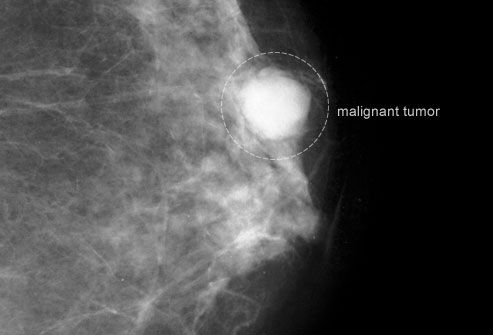
Mammogram Showing Malignant Tumor

    Screenings are a vital part of leading a healthy lifestyle because your doctor can catch a disease in the early stages when there is still a good chance to cure it. There is a lot of different information out there on who should get screened for what and when in regards to breast health. Most of the information will be based on the United States Preventative Task Force recommendations (USPSTF).


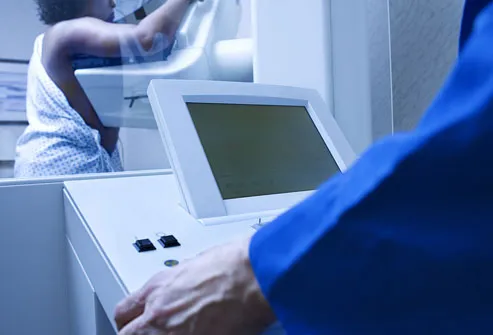
Woman Getting a Mammogram

WHO should get screened for breast cancer?
  •  All women should get screened for breast cancer no matter your race or ethnicity!
WHAT does breast cancer screening entail?
  •  Breast cancer screening entails self breast exams, clinical breast exams, ultrasound and mammography.
    • Self breast exams: I personally do not discourage women from doing monthly breast self exams (BSE), although it is no longer recommended that doctors teach their patients to do self breast exams because adequate evidence suggests that BSE do not reduce breast cancer mortality.
    • Clinical breast exams: Performed by a doctor, the clinical breast exam will look for major differences between the size of the two breasts, changes in color, abnormal discharge from the nipple, tender areas,and dimpling/ abnormalities of the skin. Clinical exams not only include the breast but the chest wall area above the breast, the underarm areas which have breast tissue, as well as lymph nodes.
    • Breast Ultrasound: if your doctor feels something suspicious in your breast, he/she may opt for an ultrasound first to get an initial clue to the anatomy of the tissue. Ultrasounds are usually preferred for women who are under 40 years old, or have low risk factors for breast cancer. 
    • Mammography: mammograms are low-dose radiation X-rays that can find a lump before you even know it's there. They are able to give a more accurate view of breast tissue and anatomy. They are highly sensitive for picking up abnormalities however normal results don’t always completely rule out cancer. Mammograms are the BEST way to screen for breast cancer.
    • If your mammogram is suspicious, the next procedure will most likely being a breast biopsy where a sample of breast tissue is examined under a microscope to look for malignant (cancerous) cell
    •  Women who have had breast cancer in the past and had a mastectomy, radiation or chemotherapy must STILL get yearly mammograms!
WHEN should women get screened for breast cancer?
  • While you are in your 20's and 30's, your doctor may preform clinical breast exams once every 1-3 years.
  • These exams may be performed by your primary care physician and/or Ob/GYN
  • The USPSTF recommends screening mammography for women aged 50 to 74 years every 2 years.
  • The decision to do a screening mammogram a woman below 50 years will be determined based on her risk factors including family history of breast cancer and any changes in her breasts. These women may also have mammograms yearly rather than every other year.
WHERE can women get screened for breast cancer?
  • Your primary care physician's office is a great resource and often a 1 stop shop for many screenings.
  • If you do not have insurance here are some other options:
    • CDC's National Breast and Cervical Cancer Early Detection Program (NBCCEDP) provides access to breast and cervical cancer screening services to underserved women in all 50 states, the District of Columbia, 5 U.S. territories, and 11 tribes.
    • Also, look out for health fairs in your area that may offer free breast cancer screenings
    • Contact your local health department to see if they offer any free screening resources.
  • More information on screening can be found here: United States Preventative Task Force- Breast Cancer Screening
WHY should women get screened for breast cancer?
  • Breast cancer is the 2nd most common cancer in women in the USA, only coming in second to non-melanoma skin cancer. It is also one of the leading causes of cancer death among women of all races. 
  • Here is the most recent data we have from the CDC, in 2009:
  • 211,731 women in the United States were diagnosed with breast cancer.
  • 40,676 women in the United States died from breast cancer.
Tell your mother, daughters, and friends to get screened and if you are a mother, daughter or friend don't forget to get yourself screened as well!