Tuesday, March 18, 2014

New Series Alert: "How I Did It"

Hi Ohemaas and Ohenes!

We are introducing a new series called, How I Did It, an interview series where we ask young professionals the really tough questions about their careers and the journey they are taking (or took) to get to where they want to be. The purpose is to inform readers about the good, bad and ugly parts of desirable careers and to inspire those who are thinking of pursuing certain careers.

When we were growing up, we had no ideas what it meant to pursue a career in medicine. If we would have listened to people who only had opinions on the matter we may not be doctors today. Therefore, we hope to make the interviews as real, transparent and raw as possible.

If there's anyone you want us to interview or any questions you want to ask the interviewee please leave a comment! Also, please share the link with anyone you know who may be interested in the featured career.

Thanks!
- Ohemaas, MD


Wednesday, March 5, 2014

The Other Side of the Stethoscope

Source
                                                                       
For the better part of residency I have been blessed with good health despite being surrounded by others who aren't feeling well. The day finally came a few months back when my health took a (slight) turn for the worse and I found myself sitting on a cold examining table. While waiting in the
room alone after the nurse had taken my vitals and asked me tons of questions I knew the doctor would ask again (don't you hate that!) I asked myself, "How did I end up here?!" "How did I go from being the caregiver to the receiver?!" I was now the patient and I was not feeling it!

 It's been said that doctors (and most medical professionals) make the worse patients. We are notorious for not seeking help until the last minute, sweeping symptoms under the rug, and not taking the same treatment we offer our patients. I was the perfect example of these tendencies. From self-diagnosing and self-medicating ( because I know what's wrong, right?), to working while sick when I clearly should have taken off, to even refusing pain meds because I didn't want to become "addicted like my patients" I was the epitome of every doctor's worse nightmare.

Source
There is a level of immunity built by working in a health care center, however chronic fatigue and sleep deprivation from working 60+ hours a week can make you vulnerable to any bug dying to have a  field day with your immune system. Getting sick was the reality check I needed. I thank God everyday for the opportunity to fulfill my dream of being a physician but in all honesty, my own health and safety should take precedence over my career.  There is no way I can care for others if I am not at my optimal best.


Source


Being on the other side of the stethoscope was an eye opener. I experienced the patient perspective and many of the sources of  frustration- the long wait time, scheduling conflicts, cancellations, co payments! I also felt the fear, anxiety, and vulnerability that occurs when you place your well being in the hands of another.

One thing I appreciate from my experience and hope to emulate as a care provider is the empathy I felt from my doctor- I sensed he was truly concerned with my health and wanted me to get better. I also hope to become more patient with answering questions, because I sure did bombard my
physician with several! As I look towards my future practice I hope to use this experience to build a stronger doctor-patient relationship and use both perspectives to provide optimal care. And now when I say "I know how you feel" I will truly mean it.

Ohemaa's MD

Sunday, February 23, 2014

OBAMACare: Breaking Down the Hype


Confusing. Revolutionary. Possibly good. Possibly bad. Embarrassing. Worth a shot, I guess? 


Americans are widely divided when it comes to The Affordable Care Act or OBAMAcare, as the law is either affectionately or un-affectionately called, depending on your stance. The purpose of this post is to break down the key features of the law, and to shed light on its advantages as well as detail the points of its biggest critics. Whether we love it or loathe it, it's the law and we are all required to be compliant with it!

Key Features of the Affordable Care Act (from HHS.gov/healthcare)
- Coverage Ends Pre-Existing Condition Exclusions for Children: Health plans can no longer limit or deny benefits to children under 19 due to a pre-existing condition.
- Keeps Young Adults Covered: If you are under 26, you may be eligible to be covered under your parent’s health plan.

- Ends Arbitrary Withdrawals of Insurance Coverage: Insurers can no longer cancel your 
 coverage just because you made an honest mistake.
- Guarantees Your Right to Appeal: You now have the right to ask that your plan reconsider its denial of payment.
- Costs Ends Lifetime Limits on Coverage: Lifetime limits on most benefits are banned for all new health insurance plans.
- Reviews Premium Increases: Insurance companies must now publicly justify any unreasonable rate hikes.
- Helps You Get the Most from Your Premium Dollars: Your premium dollars must be spent primarily on health care – not administrative costs.
- Care Covers Preventive Care at No Cost to You: You may be eligible for recommended preventive health services. No copayment.
- Protects Your Choice of Doctors: Choose the primary care doctor you want from your plan’s network.
- Removes Insurance Company Barriers to Emergency Services: You can seek emergency care at a hospital outside of your health plan’s network.

FYI

·         October 1, 2013: Marketplace open enrollment started
·         January 1, 2014: Health coverage can start
·         March 15, 2014: Enroll by this date for coverage beginning April 1st
·         March 31, 2014: Open enrollment ends for 2014!!! 

Critiques of the Act (from obamacarefacts.com)
-Taxes. Taxes on Small Business. 0.2% of firms in the US have over 50 full-time employees and will have to choose to insure full-time workers or pay a fine. To avoid this some businesses will cut employee hours, not hire or increase costs for consumers. However, the fine isn't paid for your first 30 workers. 
-Religious Beliefs.There is some argument over ObamaCare funding women's health services like contraception. Pro or con depending on your beliefs.
-Tax for Not Buying Insurance. The first year it is $95 or 1% of your income.
-Big Business Taxes. Medical device taxes and "drug innovator" taxes dig into the profits of some of the power houses in their respective industries. These industries drive up the cost of health care, thus they are taxed to help pay for health care reform. However, taxes on large businesses may have unintended consequences in the job market and in aspects of the health care industry. 
-Taxes on the 2%. The top 2% of businesses and individuals in the US will pay some extra taxes. 
-ObamaCare Hurts Medicare. ObamaCare cuts $716 billion from Medicare and reinvests the money back into the program. 
-ObamaCare Cost. ObamaCare is projected to cost $1.1 trillion over the next ten years, and in order for the program to work as intended this is going to include funding from the tax payers and from the States. However, the end result of ObamaCare's spending is a $200 billion dollar reduction of the deficit over the next decade. Nevada and Michigan have done studies that show how the States can save billions with ObamaCare. Health Insurance companies stand to make billions, despite a loss on profit per plan, since they will be insuring millions of new Americans.

Want to know more? Check out this simple and informative video:


Take care of you!

Much Love,
Ohemaas, MD


Monday, September 23, 2013

Night Owl

So second year is here....and what a welcome it has been! I was lucky enough to have a smooth transition from intern to senior and felt I had a good handle on things...until night float started. Night float consists of working 6 nights a week ( yes only 1 day off ) for 12 hours; admitting patients,managing those currently in the hospital, and running any codes that occur overnight. 1 week would drive anyone crazy- I did 3 in a row!


Source

Night float is draining...physically, mentally, and emotionally. Humans are not meant to be nocturnal, so sleeping during the day and working at night is very demanding. At first I had no problem sleeping throughout the day but as the days wore on I found myself sleeping less and less; sometimes only for 3 hours. I tried everything- sleep masks to block the sunlight, ear plugs to block outside noise, sleeping pills to stay asleep- nothing helped. I woke up feeling like a zombie, and trust me working off of 3 hours of sleep is hell!


There were times  I was able to get a little sleep overnight, but nothing compares to sleeping in your own bed without the sound of a pager going off in the background. And nothing is more painful then being woken up right when you're heading into that good sleep ( y'all know what I'm talking about). 
Trying to keep a smile on my face after a rough night


At my program each morning you have to present an interesting case you admitted overnight. The intern describes the history and physical , labs, and any imaging done ( X-ray, CT scan), and the senior has to explain the assessment and plan. The most challenging part is defending your management and decisions; why you placed the patient on a certain medication, why you felt this patient warranted admission, or why you did or did not do one thing or another . It can be quite an anxiety inducing experience especially in front of 10 plus people and especially if there is a tough attending facilitating. There were days when I walked away feeling very low; I made a mistake or mismanaged someone wrong or just plain didn't have the answer. The worse part was feeling as if everyone thought I wasn't smart or capable of taking care of patients. But there was no time for feeling sorry for myself, I had to go home and (attempt to) sleep so I could come back to work that night.


Looking back I don't know how I made it through- it was simply the grace of God. I do believe I managed patients as best I could and I learned a lot from a myriad of cases. I'm grateful to my night float team who were fun to work with and helped make the time go quicker.

Needless to say nocturnal medicine is not in my future- I enjoy being in the land of daytime living way to much!

Sunday, June 2, 2013

5 Things I Learned in the ICU


We apologize for the lack of posts! April (and May) were hectic months for Jemina and I but we never forgot about you guys! Intern year is almost over (yikes!) and we're slowly transitioning into being seniors (double yikes!!).

 I recently finished a stint in the Intensive Care Unit and boy was it an experience.. If you don't know much about the ICU, it's the part of the hospital where the sickest of the sickest patients are, or patients who need close monitoring. Residents like to sometimes call it " the dungeon"; once you go in in the morning to work, you don't leave until the end of your shift. The hours are long, the cases can be quiet complex, and the emotions run high.  I started the ICU with the expectation that I would be run ragged- and I left 10 pounds lighter and with a breath of knowledge. Here's what I learned:

                 
 Dr. William Mosenthal (head of the bed on right) created the first ICU in the USA

1. You Can't Save Everyone
  Death is inevitable for all of us and the patients in the ICU are no exception. When I began I would get very emotional when we lot a patient especially if they were very young or had small children. Then a much wiser senior sat me down and explained that sometimes there is a point where
the human body is so sick that no matter what we do, we can't save a person from the natural cycle of life and death. At times death is even welcomed, especially if the individual has been suffering for quite some time.

2. Crack is Wack
Somebody lied to me when they said America had won the war against drugs. The number of patients coming in with cocaine or other inhalants in their lungs (chemical pneumonitis), heart attacks from cocaine use, or overdosing on heroine is alarming . I find myself asking "did these people not watch the after school specials on drugs?!"  Local and state wide governments need to increase their efforts to combat the alarming drug issue in this country.

3. The Will to Live is Amazing
 To see people on the brink of death walk out of the hospital is a testimony to the resilience and strength of the human body. I remember times where I would wonder if certain patients would be alive when I came to work the next day and lo and behold  I would walk in and they would be wide awake and responding.


4. Breathing is a Gift
When you can wake up and not have a machine breathing for you, you are blessed. I never realized how much we take for granted taking in breaths on our own until I entered the ICU and had to deal with ventilator machines. And from what I hear, having that tube down your throat is no fun. So go ahead, take a deep breath!

5. I'm Alot Stronger Than I Thought
 I initially dreaded the ICU for the long hours I would have to work and the non stop action I would be facing. When I look back, I don't know HOW I worked 14 hours daily with sometimes only 2 bathroom breaks and 20 minutes to eat lunch. It truly is only the grace of God that got me through and will get me through the next time I'm in The Unit.

Stay tuned for more posts and the Ohemaa's MD recap of Intern Year of residency!


Wednesday, April 10, 2013

Women's Health Screening Series: Cervical Cancer

Cervical Cancer Cells
Cervical cancer
Let's continue our series by discussing a major public health problem here and abroad: cervical cancer. The cervix is the lower, narrow end of the uterus that connects the uterus and vagina.  A common cause of cervical cancer is human papillomavirus (HPV) which is actually a type of sexually transmitted disease.
 
WHO should get screened for cervical cancer?

  •  All women with a cervix should get screened for cervical cancer no matter your race or ethnicity!
WHAT does cervical cancer screening entail?
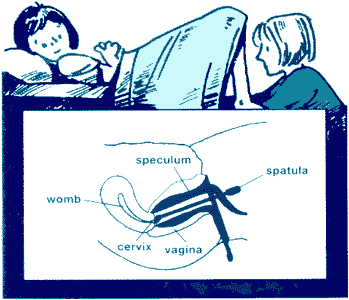
  •  Well...let's just say it involves stirrups lol. No one likes to get a pap smear. No one. However, it is very important that women do not run away from this test. During a Pap smear, your doctor scrapes some cells off your cervix and sends them to a lab for analysis. If anything unusual comes back from the lab, your doctor will let you know. (I always tell my patients to relax and scootch down to the edge of the examining table, that usually makes things go a lot faster :-)
 
WHEN should women get screened for cervical cancer?
  •  The United States Preventive Task Force recommends screening for cervical cancer in women ages 21 to 65 years with a Pap smear every 3 years.
  •  Women ages 30 to 65, who want to lengthen the screening interval, should be screened with a combination of Pap smear and HPV testing every 5 years.
  • If you have an immune deficiency, such as HIV, have a history of a high-grade precancerous cervical lesion, cervical cancer, or were exposed to diethylstilbestrol while your mother was pregnant with you, these recommendations do not necessarily apply to you and you should ask your doctor for specific recommendations.
WHERE can women get screened for cervical cancer?
  • Primary care doctor
  • OB/GYN
  • The CDC's National Breast and Cervical Cancer Early Detection Program (NBCCEDP) provides breast and cervical cancer screenings and diagnostic services to low-income, uninsured, and underinsured women across the United States. For more info click here.
 
Pap Smear Screening Test
 
WHY should women get screened for cervical cancer?
  • Cervical cancer used to be the #1 cause of cancer death for women in the United States. However, in the past 40 years, the number of cases of cervical cancer and the number of deaths from cervical cancer have decreased significantly because of PAP SMEARS!
  • Here is the most recent information from the CDC. In 2009:
    • 12,357 women in the United States were diagnosed with cervical cancer.
    • 3,909 women in the United States died from cervical cancer.
HOW can I prevent myself from getting cervical cancer?
  • The most important thing you can do to help prevent cervical cancer is to have regular screening tests.
  • Two HPV vaccines are available to protect females against the types of HPV that cause most cervical, vaginal, and vulvar cancers. Both vaccines are recommended for females 11 to 26 years of age (but can be given to girls as young as 9). It is important to note that even women who are vaccinated against HPV need to have regular Pap tests to screen for cervical cancer.
  • Men can also get HPV leading to genital warts, penile cancer, anal cancer and cancers of the head and neck. The CDC recommends the HPV vaccine for men 11 to 26. It is important to note that gay and bisexual men are at a higher risk for HPV.
  • Don't smoke. If you are going to have sex, use condoms and limit your number of sexual partners.
 
 
Decrease your risk of getting cervical cancer! Don't be afraid of needles and pap smears!!!